Researchers working aboard China’s Tiangong space station report a quantum gas with an effective temperature of approximately 9.7 picokelvin—less than ten trillionths of a degree above absolute zero. Their paper appeared in Science on November 5, 2026. The result concerns a tiny, carefully prepared cloud of atoms, not the temperature inside the station or the surrounding spacecraft.
The distinction is fundamental to understanding a striking number. Astronauts did not inhabit a room colder than any conventional freezer. Instead, an apparatus isolated rubidium atoms and reduced their motion, allowing scientists to investigate quantum behavior under conditions that are difficult to sustain on Earth.
Why microgravity matters
The reported experiment involved roughly 20,000 atoms forming a Bose-Einstein condensate. In that state, a collection of atoms can exhibit shared quantum behavior. Producing it requires extensive control: laser cooling and evaporative cooling remove energy before the cloud is released for measurement.
The team used an optical dipole trap and carefully adjusted its confinement. Making the trap wider and weaker helped reduce the energy associated with the cloud’s subsequent expansion. The achievement therefore rests on both preparing the gas and controlling how it is released, not on opening an apparatus to naturally cold space.
On Earth, an atom cloud falls under gravity. That limits the time available to observe its expansion in a laboratory, even when researchers use a drop tower. An orbiting platform provides a much longer interval of effective weightlessness, allowing a slowly expanding cloud to remain useful for observation.
In this experiment, the expansion could be followed for about seven seconds. The researchers compared their result with a previous approximately 38-picokelvin measurement associated with a two-second drop-tower experiment. Longer observation does not automatically guarantee a colder gas, but it creates opportunities for preparation and measurement that are difficult to reproduce in an ordinary laboratory.
What the temperature describes
The quoted 9.7-picokelvin value is derived from the expansion energy of the cloud. The reported uncertainty spans approximately 7.0 to 12.9 picokelvin. That range belongs alongside the headline number: an exceptionally small measurement is still a measurement with uncertainty, not an exact count without limits.
Temperature in this setting characterizes the atoms’ motion under the experiment’s conditions. It should not be confused with the ambient temperature of the instrument, the spacecraft structure or every degree of freedom in a complex system. Those distinctions become especially important when a laboratory result is condensed into the phrase “coldest place in space.”
Nor did the gas reach absolute zero. The result remains above that limit, and nothing in the reported experiment overturns thermodynamics. The achievement is a very low effective expansion temperature in a specially controlled quantum gas, a narrower and more useful statement than a sweeping claim about all matter in the universe.
Peking University’s November 6 account places the work in a development program extending back years. The experimental platform traveled to orbit aboard the Mengtian module in 2022. Its scientific output reflects that continuing infrastructure, rather than a device unexpectedly switched on for the first time this month.
Precision tool, not an instant application
Cold atoms can be useful for quantum simulation and precision measurements. Longer, slower evolution can improve the conditions for interferometry, in which researchers compare different quantum paths. Such instruments may eventually help test physical theories or measure extremely small effects.
Those possibilities should not be mistaken for completed results of this particular experiment. Reaching a low expansion temperature is one enabling step. A useful measurement system also requires control of magnetic fields, vibrations, interactions, timing and other sources of error.
Independent coverage by Phys.org and The Debrief describes the same central result, while the Science abstract and institutional explanation establish the experimental setting. The full Science article was not freely available in the materials reviewed for this report; detailed claims here are limited to those accessible sources.
The strongest conclusion is already substantial without exaggeration. An orbital experiment has demonstrated a way to prepare and observe an exceptionally slowly expanding quantum gas. That creates a platform for further work, while reminding readers that a spectacular temperature belongs to a precisely defined physical system—not to an entire space station.
Sources and further reading
This independently written report distinguishes the source publication’s topic lead from the primary records and corroborating material linked below. Historical documents and contextual images are dated explicitly.
- Topic lead: The Debrief, November 7, 2026
- Science paper abstract: Quantum gases below 10 picokelvin in space
- Peking University institutional account, November 6, 2026 (Chinese)
- Independent coverage: Phys.org, November 2026
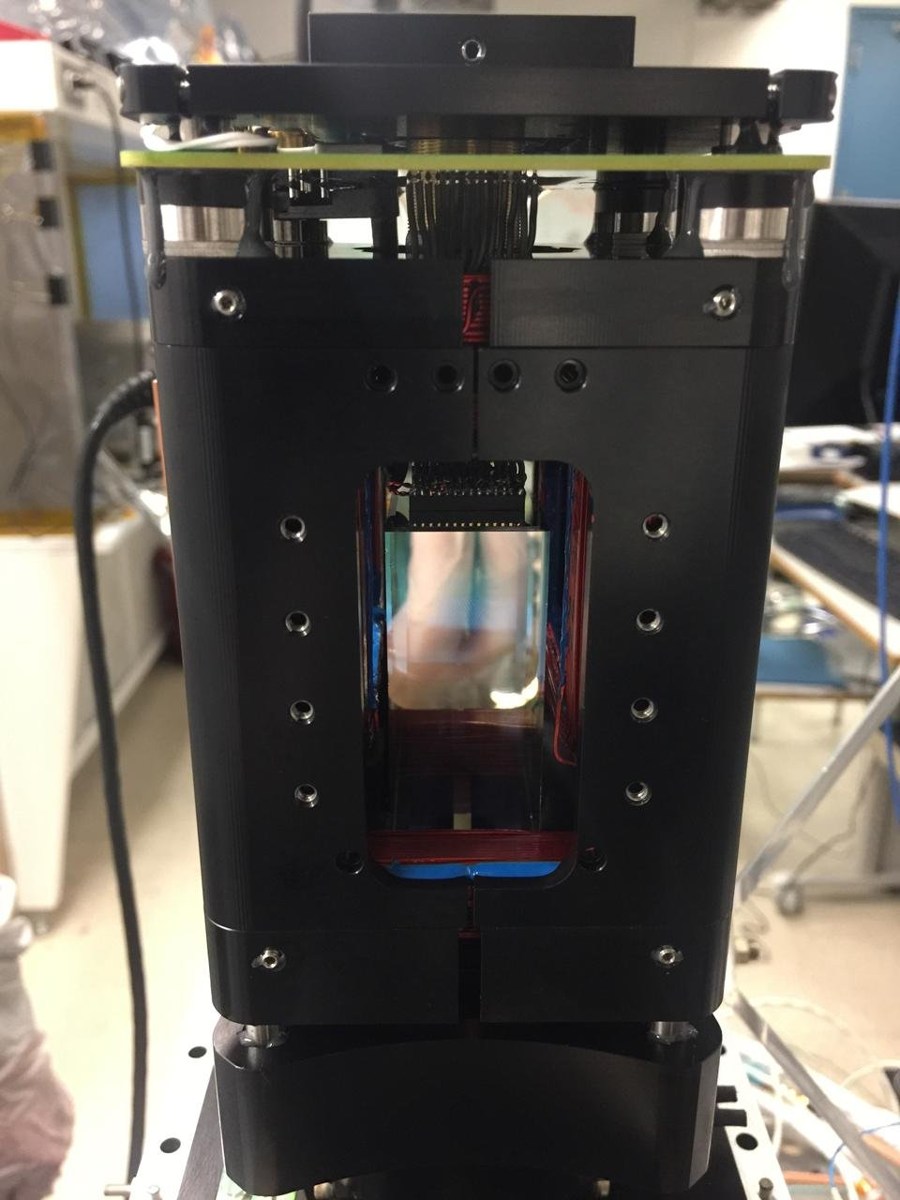
Image credit and reuse: The physics package inside NASA’s Cold Atom Lab, released July 27, 2018. Contextual archive photograph of a separate cold-atom facility aboard the International Space Station—not China’s Tiangong apparatus or the experiment reported here. Courtesy NASA/JPL-Caltech; reuse under JPL Image Use Policy. No endorsement implied. Image source and attribution · License / reuse terms. Resized and JPEG recompressed. Native thumbnails cropped.