CIA records highlighted by The Black Vault on October 7, 2026 show how officials prepared information for the public announcement of the mission that killed Osama bin Laden. The collection includes declassification requests, imagery-related authorizations, press talking points, questions and answers, and interagency guidance. It is a record of how information moved into public circulation—not a new forensic investigation of what happened inside the Abbottabad compound.
The timing needs careful handling. A CIA response dated July 6, 2026 answered a Freedom of Information Act request submitted in August 2013. Yet records inside the package bear release-approval markings from August 22, 2017, while their operational subject dates to May 2011. Calling every page a newly declassified secret would collapse several different stages of the record’s history.
The request to declassify briefing material
A May 1, 2011 memorandum from the CIA director to the director of national intelligence requests declassification of products prepared for the operation’s public rollout. It says the materials were prepared at the president’s request. The requested items include compound imagery, a line drawing, a neighborhood comparison, talking points and briefing questions and answers.
A separate memorandum authorizes imagery-derived products for unclassified use in the rollout. Together, the documents show an administrative process behind information that later appeared in public briefings. The imagery did not simply become public because somebody removed a classification label without an authorization chain.
The distinction between collecting intelligence and releasing an explanation is important. A briefing package is designed to communicate selected information to an audience. It can reveal what officials considered releasable, what questions they anticipated and how different agencies were expected to respond.
It is not automatically a complete presentation of all evidence. Classified sources, operational details, unfinished assessments and sensitive information may remain outside a press package. That limitation is a reason to examine the wider record, but it does not by itself establish that the released account was fabricated.
A public narrative with a longer paper trail
The collection includes prepared talking points and a substantial question-and-answer document. Their existence demonstrates preparation for press scrutiny. Such preparation can be examined for accuracy and omissions without treating the mere use of talking points as proof of a cover-up.
The National Security Archive’s January 2013 “Zero Dark Thirty File” provides useful independent context. It assembled official briefings, released documents and records about government cooperation with filmmakers. It also documented differences between early public statements about the raid and later corrections.
That history shows why contemporaneous accounts and subsequent documentary releases must be read together. The first public explanation of a fast-moving event may contain errors, while later revisions can improve or complicate the account. Neither a dramatic initial claim nor a later government correction should be accepted without checking what the underlying record supports.
The 2026 response also addresses another part of the original request using the CIA’s operational-files provisions. Its conditional language concerns records “should any exist.” That wording is not confirmation that particular records exist, and it should not be converted into proof that an expected record was destroyed or never created.
What the release does not resolve
The FOIA package does not independently establish every contested detail of the raid, reconstruct each participant’s actions or disclose all intelligence used to identify the compound. It is strongest as evidence of the release process and the materials prepared for public communication.
It likewise does not settle the separate debate over the role of coercive interrogation in locating bin Laden. That issue involves other records and assessments. Importing a sweeping conclusion about it into a story about briefing documents would outrun the evidence examined here.
Readers can inspect the correspondence, the internal release markings and the dated memoranda directly in the linked packet. Those features make it possible to distinguish the age of the events, the timing of earlier release decisions and the date of this particular FOIA response.
The value of the collection lies in that specificity. It adds a visible administrative trail to a heavily scrutinized national-security announcement. What it establishes is how selected information was packaged and authorized for disclosure; what remains outside that trail still requires separate evidence, rather than inference from secrecy alone.
Sources and further reading
This independently written report distinguishes the source publication’s topic lead from the primary records and corroborating material linked below. Historical documents and contextual images are dated explicitly.
- Topic lead: The Black Vault, October 7, 2026
- Primary CIA response and released records, case F-2013-02406
- Independent archival context: The Zero Dark Thirty File, January 17, 2013
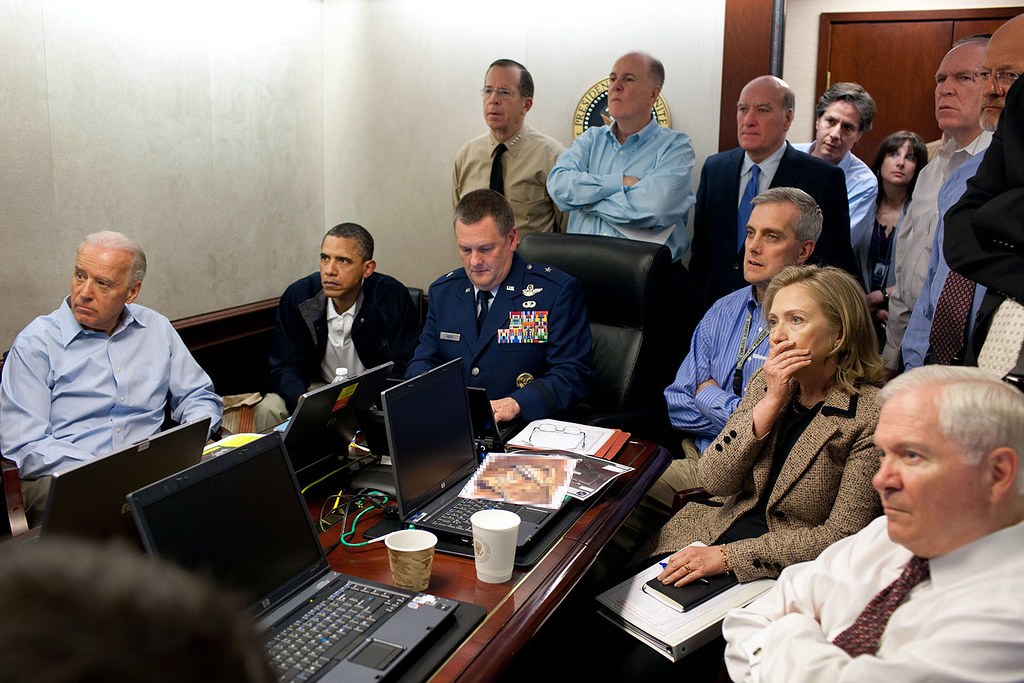
Image credit and reuse: President Barack Obama, Vice President Joe Biden and national security officials receive an update on the bin Laden mission on May 1, 2011. Official White House photograph by Pete Souza. An originally obscured document remains obscured; no editorial alteration to the scene. U.S. public domain. This is an archival mission photograph, not the 2026 records release. No endorsement implied. Image source and attribution · License / reuse terms. Resized and JPEG recompressed; native thumbnail derivatives may be cropped. No synthetic imagery.